Doktorandentag 2026 des Center for Nuclear Engineering and Sciences am PSI
Das Center for Nuclear Engineering and Sciences (NES) am Paul Scherrer Institut (PSI) hat auch 2025 seinen Doktorandentag durchgeführt. 33 Doktorandinnen und Doktoranden haben ihre Forschungsarbeiten einer Jury vorgestellt. Die vier besten Präsentationen wurden mit Preisen ausgezeichnet, die das Nuklearforum Schweiz sponserte.
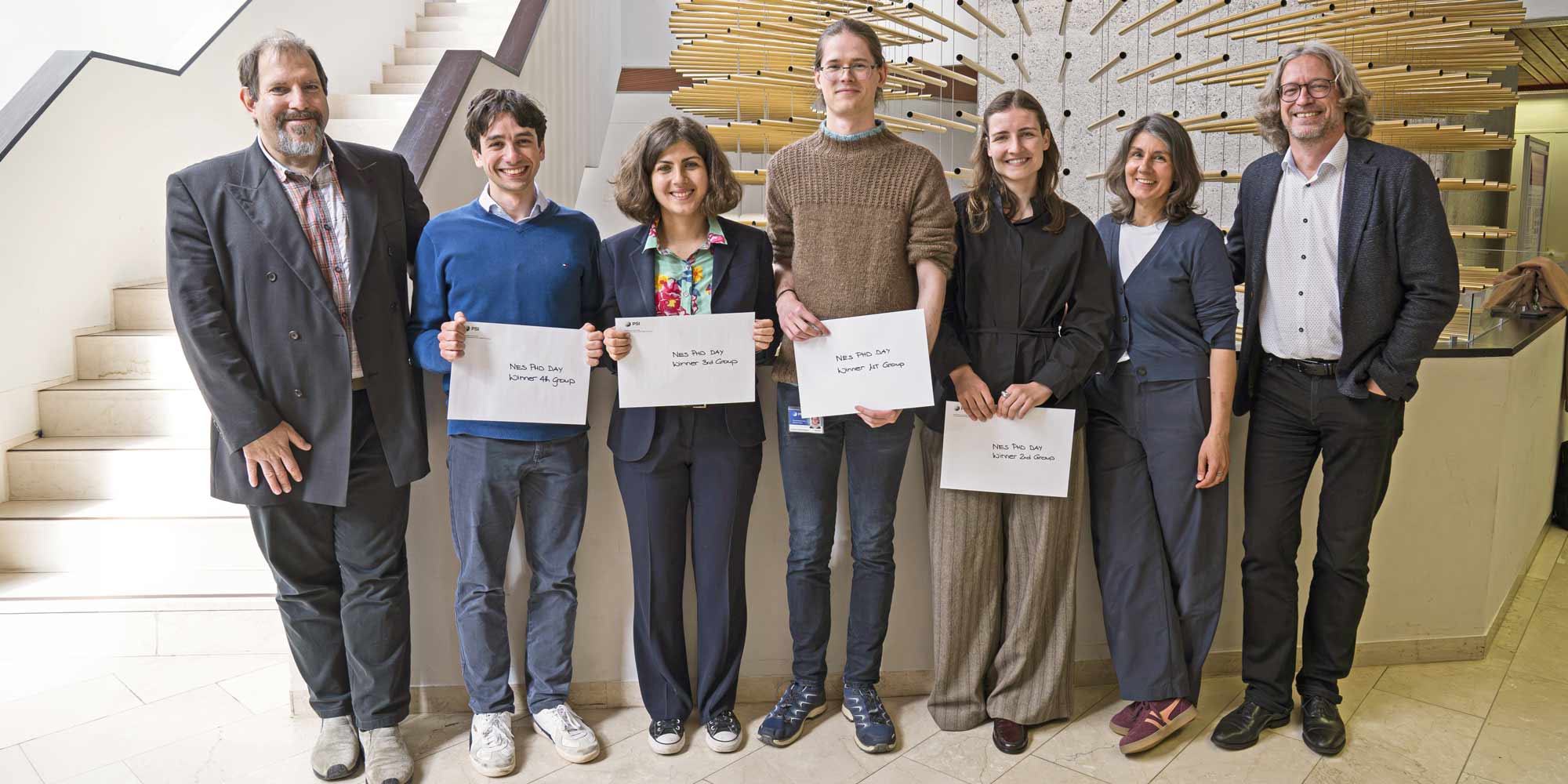
Am Vormittag präsentierten die Doktorandinnen und Doktoranden, aufgeteilt in vier Gruppen, ihre Arbeiten am jährlichen Doktorandentag des Paul Scherrer Instituts (PSI) als Poster einer Fachjury. Die jeweils zwei besten Teilnehmenden jeder Gruppe stellten ihre Arbeiten am Nachmittag in Kurzvorträgen dem anwesenden Publikum sowie der Jury vor. Die beste Präsentation jeder Gruppe wurde mit einem Preis von CHF 750 ausgezeichnet.
Das Nuklearforum Schweiz und die Jury unter der Leitung von Professor Andreas Pautz gratulieren den Gewinnerinnen und Gewinnern zu ihren ausgezeichneten Arbeiten und Präsentationen. Anerkennung gebührt zugleich allen Teilnehmenden für ihre engagierten und professionellen Beiträge.
Die Preisträgerinnen und Preisträger


Sebastian Siegrist
Erste Gruppe, Laboratory of Radiochemistry (LRC) und Abteilung für Strahlenschutz und Sicherheit (ASI) des PSIAnodic Electrodeposition for the Separation of Radionuclides of Transition Metals
The precise identification and quantification of radionuclides is essential for monitoring emissions from nuclear installations, environmental radioactivity measurements and the decommissioning of nuclear facilities. As one of the main activation products in nuclear power plants (NPP), Co-60 complicates γ-spectrometric analysis through the introduction of a pronounced Compton background, potentially obscuring less intense signals from other radionuclides. Consequently, radionuclides may require separation prior to their identification and quantification, by using well-established radioanalytical methods such as ion-exchange or extraction chromatography.
Less explored electrochemical separation methods using cheap carbon-based electrode materials could provide an alternative or complementary approach with distinct chemical selectivity. In previous studies, cathodic deposition was used to separate radionuclides of Ag, Sn, Sb, and Te from Co-60 containing samples.
Even more efficient, however, would be the direct separation of Co-60, thereby reducing the Compton background in a single step. A possible approach to achieve this might be found in the tendency of a few metals to form poorly soluble oxide species at high oxidation states. Hence, this work explores anodic electrodeposition in a three-electrode flow-through electrolysis setup as a method for fast and selective separation of Co and other transition metals from aqueous solutions. Preliminary experiments with stable Co(II) in an acetate-sulfate electrolyte resulted in separation efficiencies of > 90%.
Further results and the applicability for background suppression in γ-spectrometric measurements as well as the potential treatment of wastewater from NPPs will be discussed.

Alexandra Ermanni
Zweite Gruppe, Laboratory for Waste Management (LES) des PSIExperimental Study of 55Fe Retention and Diffusion in Cementitious Media
A lot of global infrastructure, including roads, dwellings, and deep underground nuclear waste storage facilities, relies on the combined use of steel and cement-based materials, most commonly concrete. One of the primary degradation mechanisms affecting these structures is the corrosion of reinforcing steel within the cementitious matrix, which can lead to substantial economic, environmental, and safety consequences for both individuals and the surrounding ecosystem. To mitigate these risks and ensure the long-term durability and structural safety of such infrastructure, a comprehensive understanding of steel corrosion in cementitious environments is essential.
Despite its significance, the specific processes occurring at the steel-cement interface (SCI) and their interactions remain poorly understood. Following the initiation of corrosion, a critical process at the SCI is the diffusion of iron species into the porous matrix through anodic dissolution of the steel. The diffusion of iron away from the SCI thereby influences both the rate of steel corrosion and the locations at which expansive, potentially deleterious iron-containing phases precipitate within the cement matrix.
However, there is currently a lack of robust experimental data describing the diffusion and retention behavior of iron in cementitious materials. To address the existing knowledge gap, this study presents preliminary findings from an experimental investigation of Fe(III) sorption and diffusion in white Portland cement mortar, utilizing radioactive 55Fe tracer.
Due to its low solubility at alkaline pH and strong affinity for hydrated cement phases, Fe(III) is often considered immobile in cementitious media. However, recent studies suggest that, in the presence of ligands commonly found in cement environments, such as carbonates, chlorides, or silicon, previously overlooked mobile Fe(III) complexes could exist, significantly increasing the mobility of ferric iron at the SCI. Since Fe(III) is expected to interact substantially with hydrated cement phases on its diffusive path, this study evaluates Fe(III) retention through batch sorption experiments using finely ground white Portland cement mortar and 55Fe radiotracer at varying aqueous Fe(III) concentrations.
Initial results show linear Fe(III) sorption within the measured equilibrium concentration range (10⁻⁹ mol/l < [Fe(III)]aq < 10⁻⁶ mol/l), with an average sorption distribution coefficient (Kd,mean = 97 m³/kg) about an order of magnitude lower than that observed for ferric iron sorption on the main hydrated cement phase calcium silicate hydrate (C-S-H). This experimental work offers new insights into the sorption behavior of 55Fe/Fe(III) in a white Portland cement mortar system. Additionally, the progress of ongoing 55Fe tracer-diffusion experiments using the same Portland cement mortar will be presented.

Sofia Pasolini
Dritte Gruppe, Laboratory of Radiochemistry (LRC) des PSITarget development for in-core irradiation of lanthanides in a nuclear power reactor
Radiolanthanides such as 177Lu and, more recently, 161Tb are among the most efficient radionuclides for targeted radionuclide therapy. The RAdiolanthanide Production In Core (RAPIC) project explores novel target designs to irradiate enriched lanthanide materials (i.e., 176Yb and 160Gd) directly within the core of the nuclear power plant Gösgen (KKG), Switzerland. To achieve this, the project proposes to exploit the existing Aeroball core monitoring system (AMS; used for routine neutron flux measurements inside the reactor) as an insertion pathway for specially designed target spheres.
Target materials have been developed as Pd-based alloys doped with the selected lanthanoid target element (Pd-Gd alloys were the first ones investigated). These are synthesized via a hydrogen-mediated high-temperature treatment and must comply with the stringent dimensional and mechanical specifications required by the AMS. Optimization efforts have focused on key processing parameters, including chemical composition, and heat treatment conditions, with the aim of enhancing both mechanical integrity and irradiation hardness. Structural and microstructural characterization using X-ray diffraction and electron microscopy revealed the formation of a single, stable Pd-rich phase at a Pd-to-Gd ratio of 5:1, along with a homogeneous elemental distribution throughout the bulk volume. Mechanical testing through indentation and punch experiments suggested sufficient robustness to withstand stresses associated with the insertion along the AMS pipelines. These initial results enabled the successful fabrication of spherical targets by arc melting under an Ar atmosphere, while preserving the optimized material features.
The produced spheres will then undergo neutron irradiation tests at the Swiss Spallation Neutron Source (SINQ) at PSI to evaluate the radiation hardness and to quantify the radionuclide production yields. In a final step, a suitable chemical separation and purification strategy will be devised to obtain high-purity, non-carrier-added 177Lu and 161Tb suitable for radiopharmaceutical applications. This contribution outlines the current progress of the RAPIC project, which aims to establish a scalable and sustainable production route for key radiolanthanides in commercial nuclear power plants, ultimately improving their availability in Switzerland and internationally.

Matteo Grasso
Vierte Gruppe, Laboratory for Reactor Physics and Thermal-Hydraulics (LRT) des PSIA novel individual wave velocity tracking technique for annular and film flows based on the total internal reflection method (TIRM): Line-TIRM (L-TIRM)
Annular and film flows are particularly relevant to the nuclear sector, where the presence of thin liquid films is fundamental for a stable and safe power plant operation. Two of the main examples are: boiling water reactors (BWRs) and the passive containment cooling system (PCC) of pressurized water reactors (PWRs). In the case of BWRs, annular flow characterizes the normal operating conditions of the core, here the film thickness is crucial in determining the dry-out critical heat flux, while its wavy interfacial structure is also fundamental for the momentum transfer between the gas and liquid phase. In the case of PCC instead, knowledge of the properties of the thin film is fundamental for predicting the capacity of the entire system.
However, due to the intrinsic complexity of wavy films, especially in the case of the shear driven instabilities of turbulent annular flows, their full understanding has not been achieved yet. At the same time, nuclear safety is increasingly relying on numerical models and the complexity of such simulations is also growing with a gradual shift towards CFD approaches. In this framework, high resolution experimental data is fundamental for validation of simulations, often requiring elaborate experimental setups to produce CFD grade data. Therefore, we present a novel and simple technique allowing for wave visualization and tracking in annular and film flows: the Line-Total Internal Reflection Method (L-TIRM). L-TIRM is an adaptation of TIRM using a laser line instead of a laser point. Our innovative implementation transforms a local measurement technique into a flow imaging one able to visualize the topology of thin films along a straight line, similarly to methods such as PLIF (planar laser induced fluorescence) but without need for a fluorescent dye. L-TIRM also enables wave velocity distributions measurements, allowing deep insights into the flow dynamics. The technique only needs a camera and a laser and is fully non-intrusive. We experimentally characterize L-TIRM range of applicability in upward adiabatic annular flows and verify L-TIRM measuring capabilities using optical ray tracing simulations which explain L-TIRM measurement physics. Results are then validated against the literature and the already established conductivity film sensor technology in a setup allowing simultaneous wave velocity measurement, as shown in Figure 1. Moreover, additional experiments compare L-TIRM to classic TIRM, highlighting that the former is more informative when it comes to wave analysis. However, while L-TIRM still retains some film thickness information, the measurement of this property is less robust than classic TIRM.
Quelle
NES des PSI und Nuklearforum Schweiz nach Doktorandentag vom 7. Mai 2026